
Why Pride?
A response to the people who roll their eyes in June.
On June 28, 1969, police raided the Stonewall Inn — a gay bar in Greenwich Village, New York. This was not unusual. Raids on queer establishments were routine, legal, and culturally sanctioned. What was unusual is what happened next: the community fought back. For three nights, LGBTQIA+ people — many of them transgender women of color, many of them unhoused — threw bottles, chanted in the streets, and refused to disappear. Stonewall was not a celebration. It was a riot born from exhaustion.

Two years later, the first Pride march retraced those streets. Not a parade. A protest.
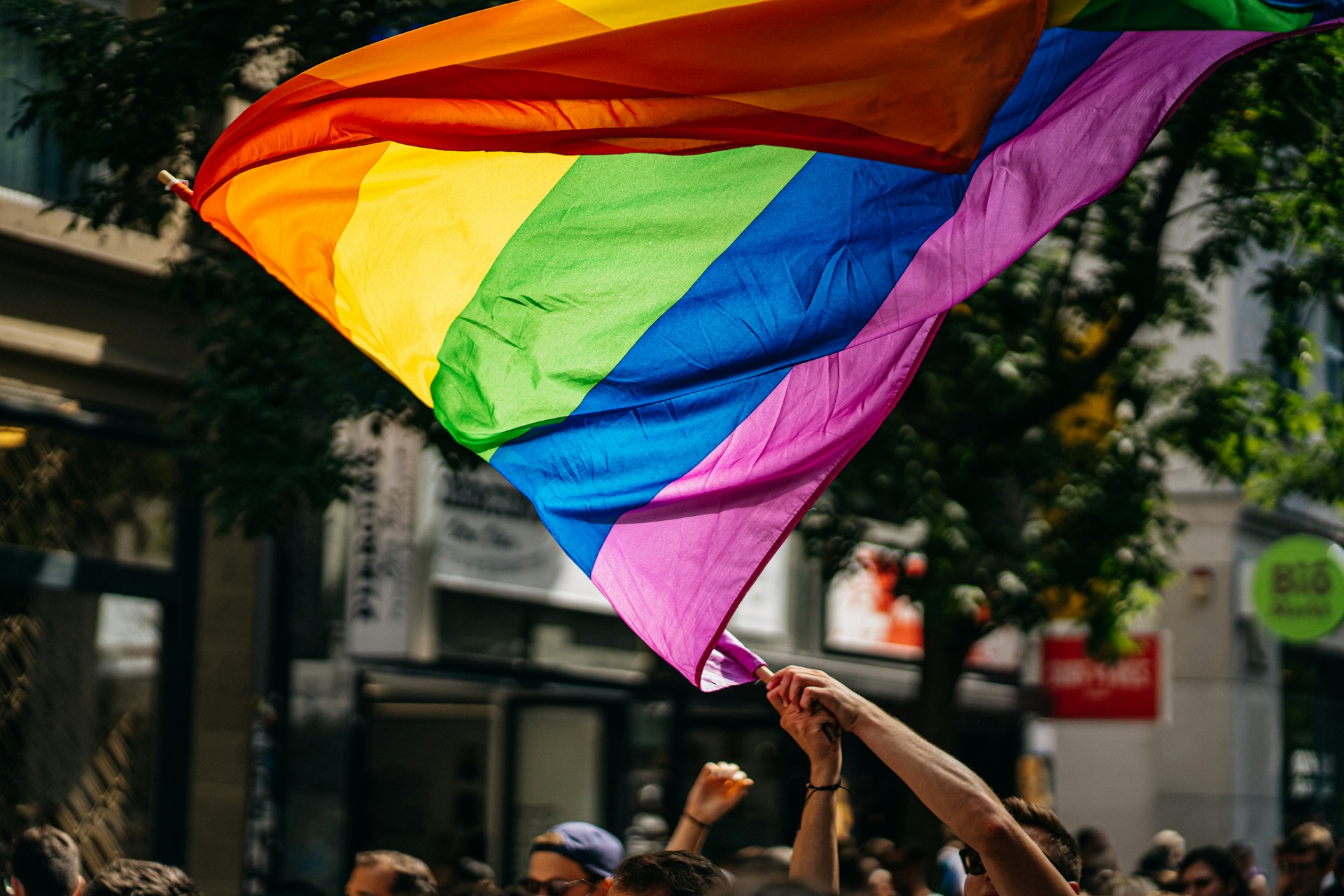
And then there’s the flag. In 1978, artist and activist Gilbert Baker created the original rainbow Pride flag at the request of Harvey Milk because he knew that in their fight for equality, the LGBTQIA+ community needed a prominent symbol to counteract the invisibility and erasure queer and trans people experienced. Baker chose the rainbow deliberately: it is a symbol that belongs to no one religion, no single culture, no government. It was not designed to intimidate. It was designed to say: we exist, in full color, and we are not going away.
That origin matters. Because Pride was never about getting in your face. It was about surviving long enough to get back on your feet.
So why do we still need it?
1. Liberation is still unfinished.
In the United States alone, over 400 anti-LGBTQIA+ bills have been introduced across state legislatures in recent years — targeting everything from healthcare access for transgender youth to which bathrooms people can use, which books can be in school libraries, which teachers can exist openly in classrooms, and who can serve in the military. Pride is not a relic. It is a response to a living political reality in which queer and trans people are still being legislated against.
2. The science is settled — the stigma isn’t.
Decades of research across genetics, prenatal biology, and developmental science have established that sexual orientation and gender identity are not choices. They are not the result of bad parenting, moral failure, or cultural contagion. They are set before birth. Homosexuality was removed from the Diagnostic and Statistical Manual of Mental Disorders in 1973 — over fifty years ago. And yet stigma, shame, and misunderstanding persist in ways that cost people their families, their jobs, their mental health, and their lives. Pride exists, in part, to say: there is nothing wrong with you.
3. Self-expression as protest.
When a system has spent decades — centuries — telling a group of people to be invisible, to be quiet, to be ashamed, then visibility becomes an act of resistance. The drag performer, the trans woman walking in heels, the teenage boy holding his boyfriend’s hand in public — these are not provocations for their own sake. They are the refusal to perform the shame the culture has assigned them. That refusal is political whether they intend it to be or not, because the pressure to hide was always political.
4. Destigmatization saves lives.
Research on minority stress is unambiguous: LGBTQIA+ people who live in high-stigma environments experience significantly higher rates of depression, anxiety, suicidality, and substance use. Visibility and community are not merely feel-good gestures — they are protective factors. When a queer teenager sees that there are adults who look like them, who are thriving, who are loved — that representation is a clinical intervention. Pride is, among other things, public mental health work.
“But it’s everywhere. It’s being shoved down my throat.”
So are churches. And crosses dangling as necklaces. And “In God We Trust” on every piece of currency in circulation. The presence of a symbol does not constitute coercion. No one is requiring you to carry a rainbow flag or attend a Pride parade or affirm anyone’s identity. Visibility and imposition are not the same thing.
What’s worth asking is: why does this particular visibility feel threatening?
A cross on a church doesn’t threaten the existence of the person driving past it. But a Pride flag, for some people, produces a different reaction — something closer to offense, or alarm, or rage. That reaction is worth examining. Because flags don’t threaten people. What threatens people is what flags represent.
For most of American history, heterosexual and cisgender identity has been in power and the unmarked norm — the default that required no explanation, no defense, no flag. Queerness was the thing that had to justify itself and fight for safety. What Pride signals — and what the current moment signals more broadly — is that the default is shifting. Diversity, not uniformity, is becoming the standard. And for people whose sense of worth has been built on belonging to the dominant group, that shift can feel like loss.
But here’s the thing about privilege: when you’ve had it, equality and equity feel like oppression.
When our sense of value or power depends entirely on belonging to the right group — on defending it, protecting it, keeping others small so the hierarchy holds — we are not operating from love. We are not operating from an awareness of inherent worth. We are operating from scarcity. And when a person’s self-knowing is that limited, the full and free expression of others will always feel like a threat, because it destabilizes the only story they’ve been allowed to tell about themselves.
When straight and cisgender people feel confused or threatened by Pride, it is rarely about the destruction of society or the watering down of morality — whatever they may say. It is about fear of loss. The loss of feeling right. The loss of perceived safety in social standards that were never actually questioned. It is the deconstruction of an award-winning performance — of what manhood is supposed to look like, what womanhood is supposed to require, what love is supposed to cost — and the unsettling introduction of a deeper truth: that those old narratives were never the whole story. They were just the only story being told loudly enough to drown out everything else.
Pride is loud because it has to be. And it will remain threatening to exactly the degree that a person’s security depends on someone else’s smallness. We are not coming to water down your religion, to threaten or weaken your marriage. We are not coming to tear down morality. We are coming for respect and equal treatment.
Stonewall was not a party. The rainbow flag was not designed to provoke. Pride exists because the alternative — silence, invisibility, shame — has a body count.
You don’t have to celebrate it. But if you find yourself threatened by it, that’s not a problem with Pride.
That’s information about you.
Isaac Archuleta, MA, LPC is the founder of iAmClinic and Graduate Professor.
